BrandBee: Earn Gift Cards
- 4.4
- Rating
- 1.00M
- Installs
- Free
- Price

 Analysis by App-foxy
I approached BrandBee: Earn Gift Cards as a lifestyle app rather than a quick-money shortcut. Its basic idea is simple: you complete available activities, such as surveys, games, receipt scans, and other tasks, then work toward rewards. That combination makes it more flexible than a survey-only app, but it also means the experience depends heavily on which activities appear for your account and how much time you are willing to spend on each one.
The app is developed by Embee Mobile and is available free of charge. It has been around since August 18, 2013, and its current version is 3.51.2. The Android requirement is 7.0 or later, so it can work on many older devices. It is listed for mature users aged 17 and over, which is worth noticing before installing it on a shared family phone or recommending it to a younger user.
My overall impression is cautiously positive. BrandBee can be useful when I treat it as a way to earn occasional rewards during spare moments, not as dependable income. The most important question is not whether the app offers several earning routes; it does. The real question is whether you are comfortable deciding what information to share, checking each activity carefully, and accepting that the value of your time may vary from one task to another.
You May Also Like

 Google Keep - Notes and lists
Google Keep’s Quiet Growth Shows the Appeal of Simpler Notes
As mobile work gets busier, Google Keep keeps winning a simple contest: capture a thought quickly, find it later, and get on with the day.

 Blood Strike: 2.5 Anniversary
Blood Strike’s Loadouts Turn Every Drop Into a Tactical Gamble
A close look at Blood Strike’s custom loadouts: how fast access to signature weapons reshapes its battle royale rhythm, rewards preparation, and narrows the gap between fights.

 Pandora - Music & Podcasts
Pandora’s Music Is Easy to Start, but Harder to Recover
Pandora’s strength is its low-effort path from a seed to a station. Its weak spot is how much confidence it asks you to place in connection, setup, and quiet recovery.

 8 Ball Pool
 Is Built on Rivalries, Rematches, and Routine
A close look at the rivalries, rematches, shared routines, and unanswered safety questions that turn a quick pool match into a persistent mobile community.

 Samsung Music
’s Quiet Strength Is Playing What You Already Own
Its reach comes less from spectacle than from dependable access to a personal library. That simplicity is both the app’s strongest retention engine and its ceiling.

 AccuWeather: Weather Radar
AccuWeather Review: A Quick, Clear Forecast for Everyday Decisions
For everyday plans, the best forecast is the one you can understand quickly. AccuWeather makes rain timing, radar, and local conditions easy to act on, with a few trade-offs.
More From Our News Desk



How BrandBee Builds Trust Through Choice and Transparency
I find that choice is most useful when it leads to a deliberate routine rather than a reflex to open every opportunity. In this section, I focus on how clear task instructions, account controls, and a little patience can help me decide what I am comfortable doing and what I would rather skip. That same habit also makes it easier to build a repeatable workflow without treating rewards as guaranteed.
A long-running rewards app with a broad user base
BrandBee has reached more than a million installs and holds a 4.4 average from roughly seventy-three thousand ratings, alongside around twenty-one thousand written reviews. Those figures suggest that the app has attracted a substantial audience and that many people have found the basic concept worth trying. They do not, by themselves, guarantee that every activity will suit every user, so I would still judge the app by the clarity of its screens and the usefulness of its available tasks.
The developer, Embee Mobile, presents BrandBee as a place where users can earn rewards through more than one type of activity. That matters because survey availability can be inconsistent. If a survey is not available, another section may offer a game, a receipt-related task, or a different way to participate. In practice, this makes the app feel less narrow than a typical opinion panel, although it also requires more attention because each activity can have its own conditions.
I would describe the app as a better fit for people who enjoy checking opportunities periodically than for anyone expecting a fixed routine. A survey app can be easy to understand: answer questions, collect points, and redeem them. BrandBee adds variety, but variety also creates more decisions. You need to read what an activity asks for, estimate the time involved, and decide whether the reward seems reasonable before starting.
What the free price really means for the user
There is no purchase price to get started, which lowers the barrier to testing it. That does not make your time free, however. A task that takes several minutes, asks for careful receipt information, or requires you to play repeatedly should be judged by the effort involved rather than by the fact that no money leaves your bank account.
My advice is to begin with a small trial. Explore the available sections, understand how progress is recorded, and avoid changing your routine around the app until you know whether the activities shown to you are worthwhile. This is also a sensible way to decide whether the app’s account and reward experience feels comfortable before you invest more time.
One useful habit is to separate “interesting” from “worth doing.” A game may be entertaining but inefficient if the requirement is demanding. A receipt task may fit naturally after shopping, while a survey may be convenient during a short wait. Thinking in those terms prevents the reward language from making every activity look equally valuable.
Why the mature age label deserves attention
The mature 17+ rating is not a detail I would ignore. Parents should not assume that a rewards app is automatically suitable for children simply because its activities look casual. A teenager using it would need to understand what information an activity requests and why completing a task can involve more than tapping through a few screens.
For adults, the rating is a reminder to read each activity on its own terms. The app brings together surveys, games, and receipt scanning, so the type of interaction can change from one section to another. I would not treat a single general impression of the app as enough; I would review the wording and choices presented at the moment I start a task.
Controls I would check before doing anything sensitive
Before completing a survey or scanning a receipt, I would look for the app’s visible explanations, permission prompts, and account settings. The safest workflow is to grant only what is needed for the activity I have deliberately chosen, rather than approving every request automatically. If a feature asks for access that does not seem connected to its purpose, I would pause and reconsider.
I would also inspect the account area for sign-in details, notification controls, and any options related to participation or communication. Clear controls are important because rewards apps can become noisy if every available opportunity generates an alert. Turning off unnecessary notifications can make BrandBee feel like an occasional tool instead of something that constantly competes for attention.
Another practical check is whether the app lets me review an activity before committing. I want to know the general task, the expected action, and the reward conditions before I spend time on it. If the wording is vague, I would avoid guessing. A small reward is not worth completing a task I do not fully understand.
Data-sensitive moments inside ordinary use
The most sensitive moment is likely to be receipt scanning. A receipt can reveal more than a purchase total: it may show a store, a date, product choices, and other details about a shopping trip. I would only scan receipts that I am comfortable submitting for the stated activity, and I would check the image before sending it to make sure it does not include unrelated paperwork or personal notes.
Surveys deserve a similar pause. Questions can feel harmless when viewed one at a time, but a series of answers may create a detailed picture of preferences, habits, or circumstances. I would answer only what I am comfortable sharing and would leave an activity if its questions crossed a personal boundary for me. The reward should never pressure me into providing information I would normally keep private.
Games create a different kind of sensitivity. They may be less personal than a survey, but they can consume more time and encourage repeated checking. I would set a limit before starting. For example, I might try a game during a commute or while waiting for an appointment, then stop when the time I planned to spend is over. That keeps the activity from quietly replacing something more useful.
Notifications are another user-choice issue. A reminder can help me notice a short-lived opportunity, but too many alerts can encourage impulsive participation. I prefer to review opportunities when I choose. If the notification settings are available on my device or inside the app, I would reduce them to the level that feels useful rather than leaving every alert enabled.
How I would use the app during a normal day
Imagine I have finished grocery shopping and have a receipt in my bag. Instead of opening BrandBee immediately at the checkout, I would wait until I am somewhere private and have enough time to inspect the task. I would check whether the receipt fits the stated requirements, photograph it clearly, and review the image before submitting it. If the task requires details I do not want to share, I would skip it rather than forcing the situation.
Later, while waiting for a train, I might look at surveys or games. I would choose one activity, note what it asks me to do, and avoid opening several tasks at once. This prevents unfinished activities from taking over the session and makes it easier to judge which type of task actually suits my routine. Afterward, I would check whether the reward or progress was recorded as expected instead of assuming that closing the screen completed everything.
This workflow highlights one of BrandBee’s strengths: it can fit around moments that already exist in my day. It also shows the main trade-off. The app does not remove the need for judgment. I still have to protect my attention, review information requests, and decide whether a particular opportunity deserves my time.
When BrandBee is better than a single-purpose alternative
Compared with a survey-only service, BrandBee offers more ways to participate. That is useful when I do not qualify for a survey or simply do not feel like answering questions. Receipt scanning can fit naturally after shopping, while games may appeal to someone who prefers an interactive activity during downtime.
The broader selection can also make the app less predictable. A focused survey service may be easier to understand because its purpose is narrow. With BrandBee, I need to compare different activities myself. Someone who values a straightforward, repeatable process may prefer a simpler alternative, even if it offers fewer types of tasks.
BrandBee is also different from cashback services that automatically track purchases through a linked account or shopping portal. Here, the receipt-scanning route requires a deliberate action from me. That can offer more control over what I submit, but it also means I must remember to keep the receipt, check its quality, and complete the process correctly.
It is not a replacement for employment, freelance work, or a reliable budgeting method. The app belongs in the “small extras for spare time” category. If your goal is predictable monthly income, I would choose a different solution entirely. If your goal is to turn occasional waiting time or routine shopping into modest reward progress, the broader activity mix may be more appealing.
Small habits that improve control and reduce wasted effort
- Read before tapping through: I would review the activity’s instructions first, especially when a receipt or personal answers are involved.
- Use a time boundary: I would decide how long I am willing to spend on a game or survey before beginning it.
- Keep submissions deliberate: I would inspect receipt images and avoid including unrelated documents or information.
- Review account choices: I would check notifications and participation controls so the app fits my routine rather than interrupting it.
- Track patterns: After several sessions, I would notice which activity types feel worthwhile and ignore the ones that repeatedly consume too much time.
These habits are more important than chasing every available task. They keep the user in control and make it easier to decide whether BrandBee is genuinely useful. In my experience, the best rewards-app workflow is selective: complete the activities that naturally fit your day and skip the rest without feeling that you are missing out.
What may frustrate new users
The biggest source of friction is the variable nature of the activities. A person opening the app with one expectation may find that the most appealing option is not available at that moment, or that a task takes more concentration than expected. That is not necessarily a defect, but it does mean the app should be approached as an opportunity list rather than a guaranteed schedule.
There is also a risk of undervaluing time. Surveys can look short, games can feel entertaining, and receipt scanning can seem effortless, yet the combined steps may take longer than expected. I would judge the experience over several sessions rather than deciding after one unusually good or disappointing task.
Another possible frustration is the need to stay organized. Receipts can be misplaced, notifications can become distracting, and unfinished activities can blur together. Users who want a completely passive reward system may find this style of participation too hands-on. BrandBee works best when I treat it as a small personal project, not as background magic.
Who should try it and who should skip it
I would recommend trying BrandBee to adults who enjoy surveys, do not mind occasional receipt scanning, and like having games as an alternative way to participate. It is especially suitable for someone who already has short waiting periods in the day and can use them without sacrificing work, rest, or family time.
I would be more cautious about recommending it to anyone who is uncomfortable sharing shopping information or answering personal questions. The mature age label also makes it unsuitable as a casual recommendation for children. People with very limited data, storage, or battery tolerance should review the app’s behavior on their device and avoid enabling anything they do not need.
I would also skip it if I needed guaranteed earnings, instant results, or a fully automatic experience. A dedicated budgeting tool is better for tracking spending, a conventional cashback service may be better for purchase-linked savings, and paid work is better for dependable income. BrandBee’s value comes from flexibility, not certainty.
My cautious verdict after weighing control against convenience
BrandBee: Earn Gift Cards is a credible-looking option for adults who want several reward activities in one lifestyle app and are willing to make careful choices. Its free entry, established presence, and 4.4 average from a large rating base make it reasonable to test. The developer is Embee Mobile, and the app’s current version is 3.51.2, so users with Android 7.0 or newer can consider it if the experience suits their device.
Still, I would not install it with the expectation that every task will be equally valuable or consistently available. The strongest approach is selective participation: inspect the activity, protect sensitive information, control notifications, set a time limit, and confirm that your effort was recorded. Those steps turn the app from a vague promise of rewards into a more manageable personal routine.
My recommendation is to try BrandBee cautiously, with your time and information treated as the real costs. If you enjoy switching between surveys, games, and receipt-based activities, it may be a convenient addition to your phone. If you want predictable income, passive rewards, or minimal data-related decisions, another type of app will serve you better.
FAQs for BrandBee: Earn Gift Cards
01What is BrandBee: Earn Gift Cards and how does it work?
BrandBee: Earn Gift Cards is a rewards app that lets users earn points by completing activities such as surveys, sharing opinions, and participating in market research. After collecting enough points, you can usually exchange them for available gift cards or other rewards. The number of opportunities may vary depending on your location, profile, and current campaigns.
02Is BrandBee: Earn Gift Cards free to download and use?
Yes, BrandBee is generally free to download and use, with no required subscription to create an account or browse available earning opportunities. However, the app may require personal and demographic information to match you with surveys and research tasks. You should review its privacy policy and permissions before registering, especially if you are concerned about how your data is collected or used.
03How do users earn rewards in BrandBee?
Users can earn rewards by completing eligible surveys, answering market research questions, and participating in other activities offered through the app. Each task normally displays its expected reward before you begin, although eligibility can change after screening questions. To maximize your earnings, keep your profile accurate, check the app regularly, and answer consistently rather than rushing through questionnaires.
04How can I redeem points for gift cards in BrandBee?
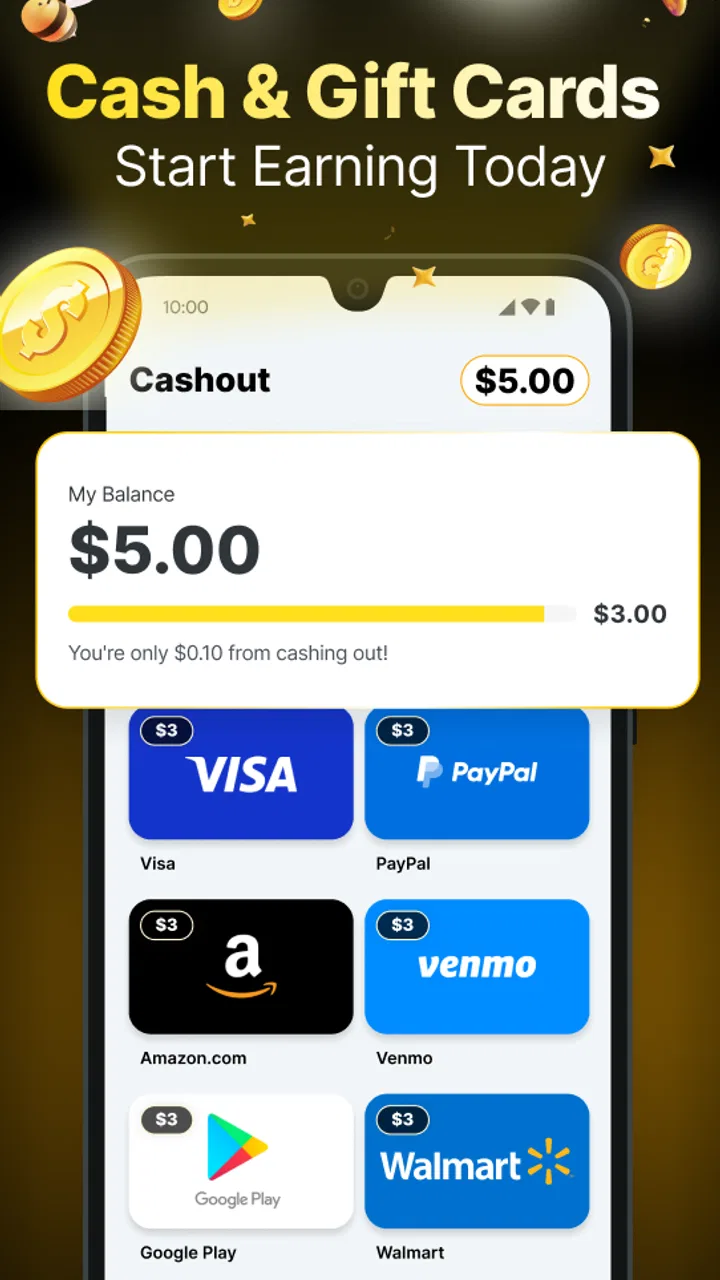
Once your account reaches the minimum redemption threshold, you can open the rewards or cash-out section and select an available gift card option. The exact brands, denominations, and redemption requirements may depend on your country and current inventory. Processing is not always instant, so allow time for verification and delivery, and make sure your account details are correct.
05Is BrandBee: Earn Gift Cards legitimate and worth downloading?
BrandBee can be useful for earning occasional rewards from spare time, but it should not be viewed as a replacement for regular income. Survey availability, qualification rates, and payout speed can differ considerably between users. Before downloading, check the latest store reviews, read the privacy terms, and understand the minimum payout requirements. Results are usually best for users who are patient and consistent.
Pros
- Simple tasks make earning rewards easy for beginners.
- Gift card options suit users who prefer shopping rewards.
- Short activities can fit conveniently into spare time.
- The app offers a low-commitment way to earn small bonuses.
- Progress toward available rewards is easy to understand.
Cons
- Earnings are usually modest compared with the time required.
- Task availability may vary depending on your location.
- Some offers can include lengthy surveys or qualification screens.
- Gift card redemption may require reaching a minimum balance.
- Privacy-conscious users may dislike the data required for surveys.

BrandBee: Earn Gift Cards
Gallery